
Fairfield County Criminal Court Records
A criminal court record is the case file kept by the court after a criminal matter is filed. In Fairfield County, Circuit Court criminal cases are heard on the General Sessions side, and the Clerk of Court keeps criminal case records heard there. Summary-level criminal matters may remain in Magistrate Court or Municipal Court. Those lower courts also handle many traffic, bond, preliminary hearing, warrant, and failure-to-appear matters before a case is resolved or moves upward.
The full criminal court record is different from an arrest record. An arrest or booking record is tied to law enforcement or the Detention Center, while the court file tracks the judicial case. A closer look at charges after arrest belongs with Fairfield County arrest records and charges. The criminal court record focuses on what the court did with the charge: arraignment, motions, pleas, trial, verdict, disposition, sentence, probation terms, bench warrant entries, and post-disposition actions when public.
The Sixth Judicial Circuit matters because Fairfield County shares a circuit with Chester and Lancaster Counties. The Sixth Circuit Solicitor handles prosecution functions, criminal trial scheduling, diversion links, and expungement administration for qualifying charges.
Search Fairfield County Criminal Records
Start with the South Carolina Judicial Branch Case Records Search and use the Fairfield County Public Index for trial court records. The research notes that the official portal requires cookies and JavaScript, and some browsers may need a pop-up exception for case detail. If the Public Index does not return a result or if a certified copy is required, contact the Fairfield Clerk of Court at 803-712-6526.
- Open the Judicial Branch case-records landing page and choose the Fairfield County Public Index for trial court cases.
- Search by the live fields available in the portal, usually party, case, court, or date controls when shown by the system.
- Confirm the court level, since General Sessions, Magistrate, and Municipal criminal matters can be separate.
- Read docket entries for charges, hearings, pleas, disposition, sentencing, and bench warrant activity when public.
- Call the Clerk for certified copies, older files, unclear results, or records not displayed online.
For a statewide name-based criminal history check, use SLED CATCH. It is not the same as the Fairfield County criminal court case file. The research also notes that SLED CATCH does not include wanted-person status, so warrant questions require court or Sheriff's Office channels.
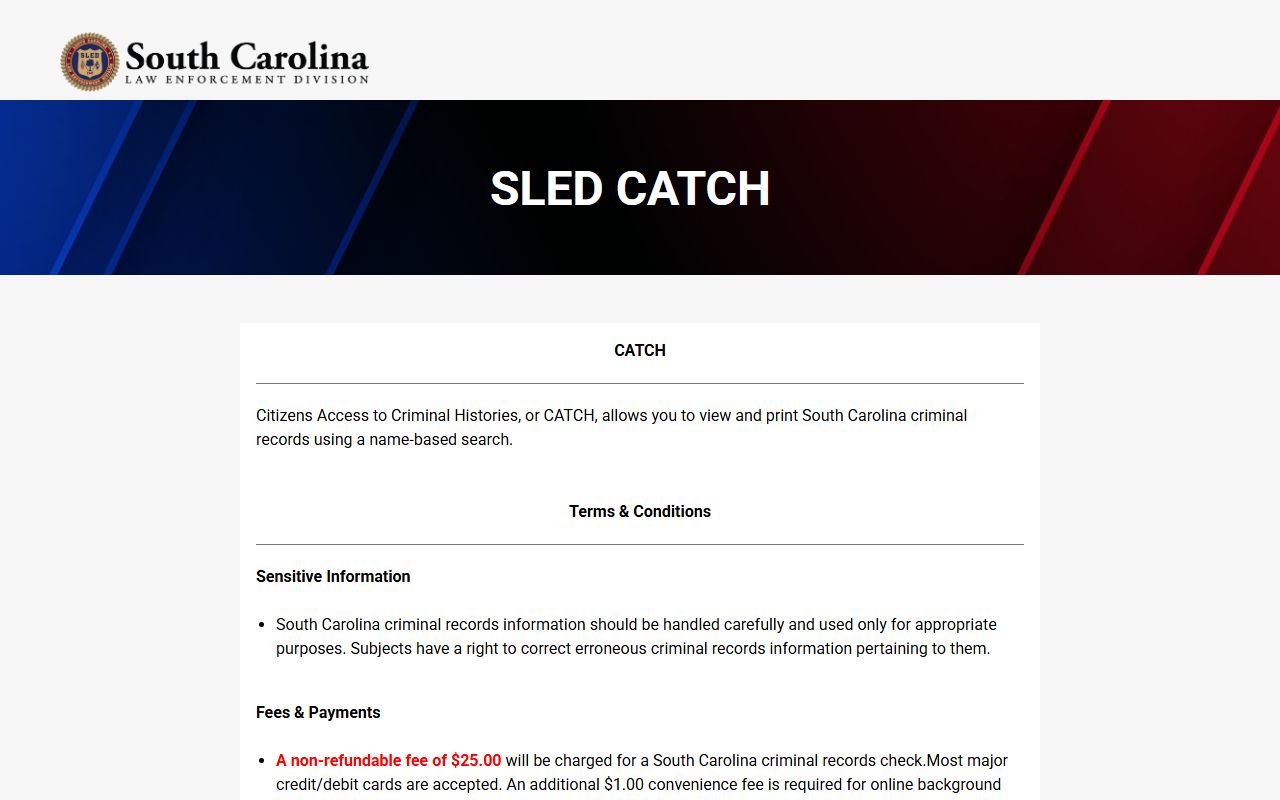
SLED CATCH can support a criminal-history request, but court disposition and sentencing details still need verification against the actual Fairfield County court record.
Fairfield County Criminal Case Stages
A Fairfield County criminal court record grows as the case moves through the courts. A lower court may handle bond, preliminary events, or a summary charge. More serious criminal matters can proceed to General Sessions, where the court file may show indictment, arraignment, motions, plea negotiations, trial events, disposition, sentence, and later probation or post-conviction activity. Some stages do not appear for every case.
Case flow: Charges Filed › Bond or Initial Appearance › Arraignment › Pretrial and Motions › Plea or Trial › Disposition › Sentencing
| Stage | What Happens |
|---|---|
| Charges filed | Law enforcement, Magistrate or Municipal process, indictment, or solicitor action starts the criminal court path. |
| Bond or initial appearance | Magistrate or Municipal proceedings advise rights, address bond, and set release conditions when allowed. |
| Arraignment | The charge is formally addressed, and a plea or later plea process may be entered into the record. |
| Pretrial and motions | Attorneys file requests, continuances, discovery issues, suppression issues, or other pretrial matters. |
| Plea or trial | The case resolves by plea, trial verdict, dismissal, or another court-approved outcome. |
| Disposition and sentencing | The record shows the outcome, punishment, probation, restitution, jail or prison terms, or other conditions when public. |
Sixth Circuit Criminal Scheduling
The Sixth Circuit Solicitor serves Fairfield, Chester, and Lancaster Counties. Research identifies Solicitor Randy E. Newman, Jr., the Winnsboro office at 101 S Congress Street, the Fairfield phone number 803-712-1735, and the mailing address P.O. Box 1085, Winnsboro, SC 29180. The Fairfield Clerk FAQ states that criminal trial scheduling is a Solicitor function, not a Clerk function.
The Solicitor's role explains why a criminal court record search may require both the court file and prosecution scheduling information.
The Sixth Circuit Solicitor staff page identifies office staff and supports direct routing for prosecution-related questions.
For expungement process questions, the Clerk FAQ directs Fairfield users to the Sixth Judicial Circuit Solicitor in Winnsboro.
What Criminal Records Show
Fairfield County criminal court records can show much more than a charge name. The useful fields are the ones that prove where the case sits and how it ended. A pending charge, a dismissed charge, a guilty plea, and a sentence are different legal events. The docket should be read with the court level in mind because Magistrate, Municipal, and General Sessions records can use different processes and can hold different parts of the same matter.
| Field | What It Shows |
|---|---|
| Case number | The Public Index or court identifier for the criminal matter. |
| Defendant | The person charged in the criminal case. |
| Court | General Sessions, Magistrate Court, Municipal Court, or appellate court when appealed. |
| Charges | The offense title, count, charge status, or indictment information when public. |
| Bond events | Bond type, amount, hearing, release conditions, or bench warrant activity when shown. |
| Plea | The defendant's response, such as guilty, not guilty, or other court-recognized plea. |
| Disposition | The outcome of the case or charge, such as guilty, dismissed, acquitted, transferred, or closed. |
| Sentence | Fine, costs, jail, prison, probation, restitution, community conditions, or other punishment when public. |
Charges vs Convictions
A charge is an accusation or formal criminal count. A conviction is an outcome after a guilty plea, guilty verdict, or another conviction-producing result. Fairfield County criminal court records may show charges that were amended, reduced, dismissed, or resolved without a conviction. That is why the disposition and sentence fields matter more than the charge title by itself.
| Charge | Conviction | |
|---|---|---|
| Stage | Filed before final outcome | Entered after plea, verdict, or qualifying adjudication |
| Meaning | Accusation or count | Finding or plea of guilt |
| Record use | Shows what was alleged or prosecuted | Shows final guilt outcome and sentencing basis |
| Can change | May be amended, reduced, dismissed, or dropped | May later be appealed, pardoned, or expunged only if law allows |
Note: A docket with a charge but no conviction should not be described as proof that the person was convicted.
Sealed and Expunged Records
Restricted criminal records include juvenile matters, sealed cases, expunged non-convictions, and records withheld by court order. South Carolina law treats juvenile identifying information as confidential except as authorized. The research also notes that expunged non-conviction records may be destroyed or retained under seal for limited law enforcement, prosecution, or facility purposes. Public-facing court searches should not be expected to reveal expunged charges.
| Sealed | Expunged | |
|---|---|---|
| Public visibility | Hidden from ordinary public access | Removed from ordinary public access and treated under expungement law |
| Who may see it | Limited parties, agencies, or people with court authorization | Very limited access if retained under seal for legal purposes |
| Fairfield contact | Court that sealed the record | Sixth Circuit Solicitor for process questions |
| Legal source | Court order or confidentiality law | S.C. Code Section 17-1-40 and Sections 17-22-910 through 17-22-950 |
Criminal Court Public Access
South Carolina's Freedom of Information Act supplies the general public-record rule for public bodies, but criminal court files are also shaped by court records rules, sealed orders, juvenile confidentiality, and expungement statutes. Section 17-1-40 addresses destruction or sealed retention of certain arrest, booking, mug shot, fingerprint, and bench warrant records after eligible non-convictions. Sections 17-22-910 through 17-22-950 establish uniform criminal expungement administration through solicitor offices.
Key Statutes:
S.C. Code Section 17-1-40 - Addresses eligible non-conviction expungement, destruction, and sealed retention rules.
S.C. Code Sections 17-22-910 through 17-22-950 - Sets the statewide solicitor-based expungement process.
S.C. Code Section 63-19-2030 - Restricts juvenile law enforcement records and identifying information.
Fairfield County Defense Contacts
The public defender office is not the custodian of Fairfield County criminal court records, but it is relevant when a defendant needs representation in a criminal or juvenile case. The South Carolina Commission on Indigent Defense county list identifies Fairfield County as Circuit 6 and gives the public defender contact channel as 803-815-4074. The Fairfield public defender listing names William P. Frick as Circuit Public Defender, Kay Boulware as Chief Public Defender, and Mark Grier as Juvenile Public Defender.
The SCCID county public defenders page provides statewide routing for indigent defense contacts.
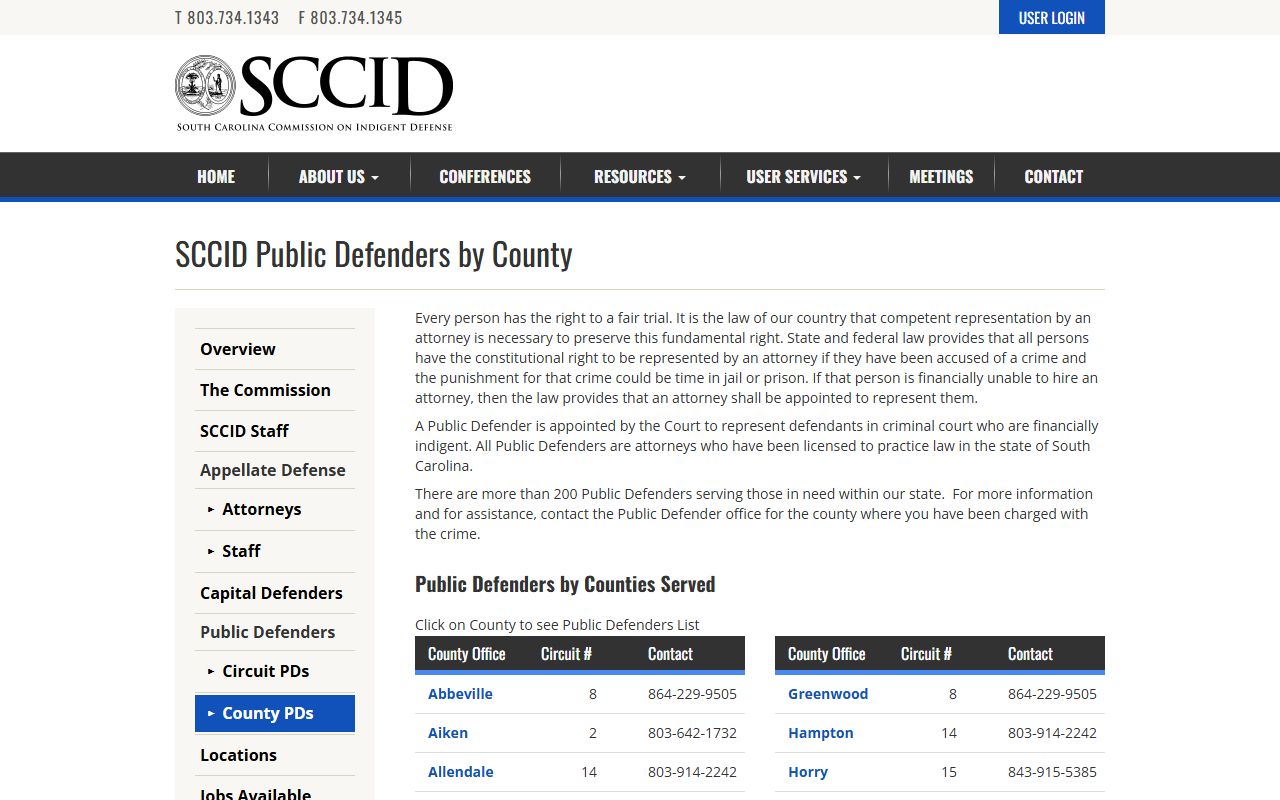
SCCID gives the statewide framework, while the county listing points to Fairfield's assigned public defender contacts.
The Fairfield County public defender listing gives the local public defender names and phone numbers captured in the research.
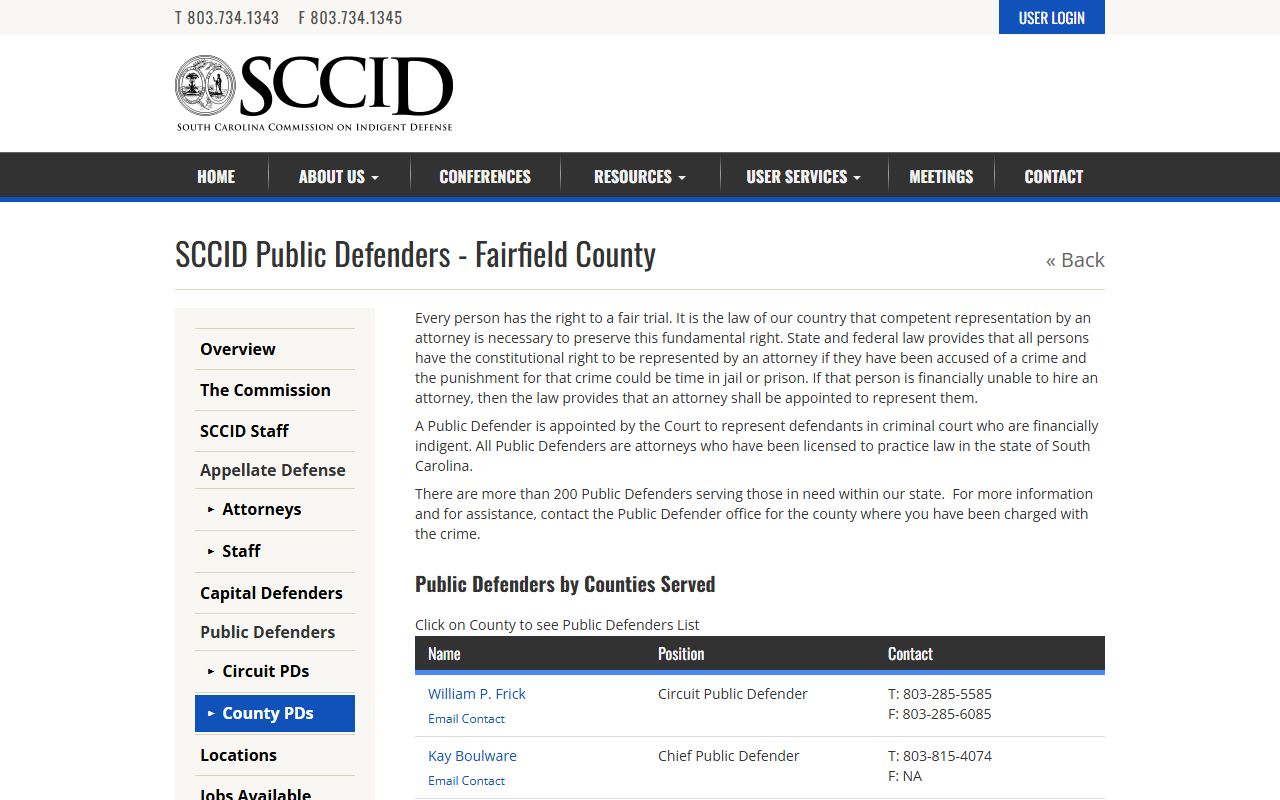
Defense contact information helps identify representation channels, but case documents still come from the court or Clerk.
Restricted Fairfield Criminal Records
Fairfield County criminal court records may be restricted when the case involves a juvenile, sealed order, expungement, protected personal identifiers, active investigation limits, or a court-specific confidentiality rule. The Judicial Branch notice captured in the research also states that home addresses are no longer displayed on the public index for new and existing cases as of January 1, 2026. That privacy rule affects what appears online even when the case itself is public.
For current custody, use Detention Center channels rather than assuming the criminal court docket is current. For active warrants, use Magistrate, Municipal, or Sheriff's Office channels. For the complete public case record, verify through the Fairfield Clerk, the court that created the record, or the Solicitor when the question concerns criminal trial scheduling or expungement.